
Chapter II, OrnamentsBuying guide
Black Christmas Ornaments: Glass, Velvet, Skull and Bat Designs
How to choose black Christmas ornaments: mouth-blown or machine-made glass, shatterproof, velvet and felt, plus cute bat, cat, moon and raven designs.
We may earn a commission when you buy through links on this page. Listings and prices come from our partners and change often. How we make money.
The short of it
- Birthplace of the glass bauble
- Lauscha, in Thuringia, Germany
- First documented bauble order
- 1848, in a Lauscha glassblower's ledger
- Machine-made glass
- Corning made 40 million clear ornament bulbs in 1940 on converted lightbulb machines
- Spider ornaments
- Ukrainian pavuchky, meaning "little spiders", made of paper and wire
- Homes with small children
- CPSC advises avoiding sharp or breakable decorations
Black Christmas ornaments come in four main materials: mouth-blown glass, machine-made glass, shatterproof plastic, and soft velvet or felt. Pick glass for shine and heirloom value, shatterproof for homes with kids or pets, and velvet for texture. Then add spooky-cute motifs such as bats, black cats, crescent moons and ravens.
What should you look for in black ornaments?
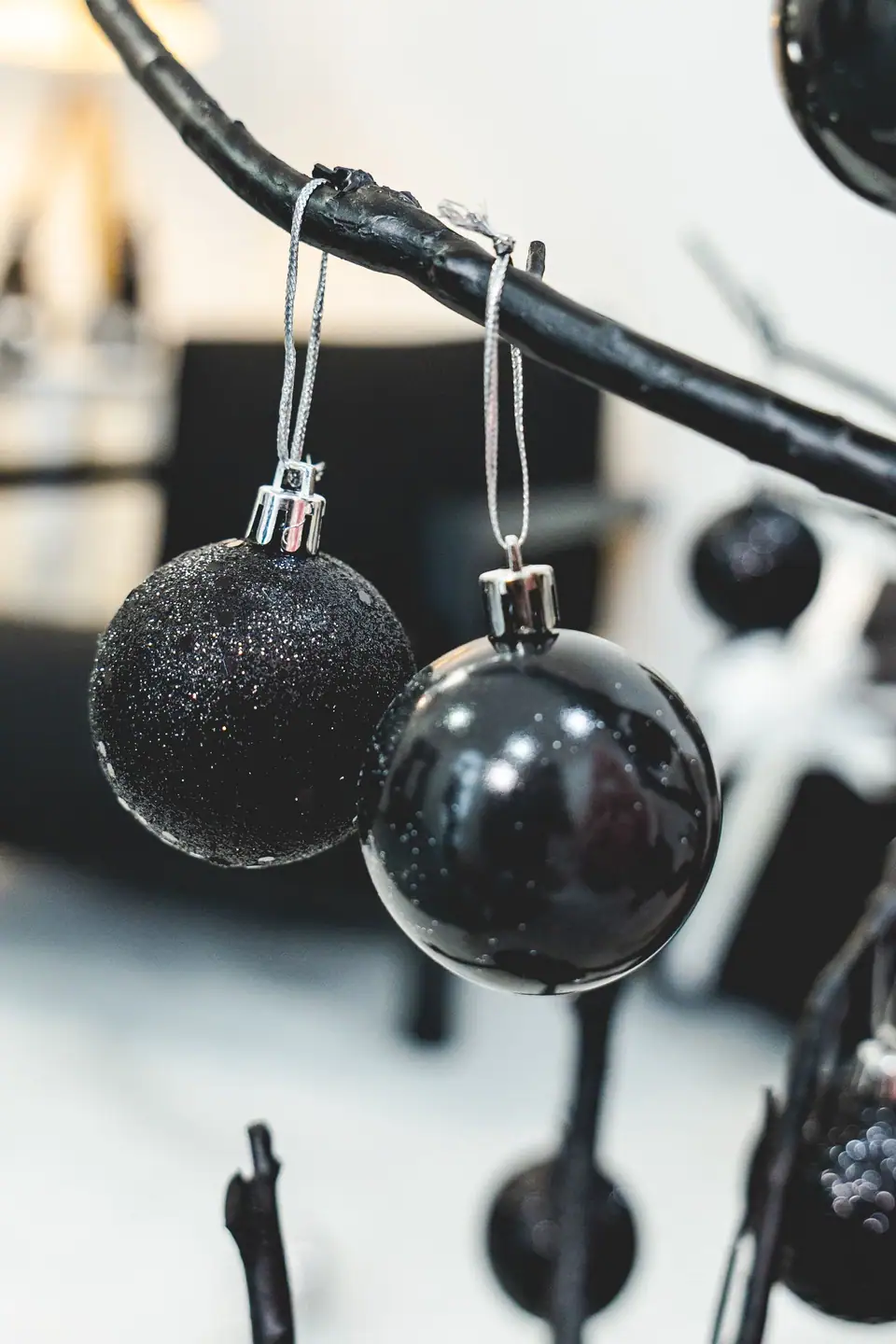
Start with the material, because it decides how the black reads on the tree. Gloss glass reflects lights, matte glass looks almost like slate, and velvet soaks up light entirely. Mixing two or three finishes gives a black tree depth instead of a flat, dark mass.
| Material | How the black looks | Breaks if dropped? | Best spot on the tree |
|---|---|---|---|
| Mouth-blown glass | Glossy, hand-painted detail, unusual shapes | Yes | Upper and middle branches |
| Machine-made glass | Even gloss or matte, uniform sets | Yes | Anywhere out of reach of kids |
| Shatterproof plastic | Gloss, matte or glitter, lightweight | No | Lower branches, busy homes |
| Velvet and felt | Soft, deep, no shine | No | Anywhere, including low branches |
Check the hanger too. Heavy figural glass needs a sturdy hook and a strong branch, while felt and plastic hang from almost anything.
Mouth-blown or machine-made glass: what is the difference?
Mouth-blown glass and Lauscha
The glass bauble traces back to Lauscha, a glassmaking town in the Thuringian Forest of Germany. The Thuringia tourism board says the first documented order for “Weihnachtskugeln” (Christmas balls) appears in a glassblower’s ledger in 1848. Glassblowing in the valley goes back much further, to a glassworks founded by Hans Greiner and Christoph Müller at the end of the 16th century.
Early baubles were silvered inside with a silver nitrate solution, a technique developed in the 1850s by the chemist Justus von Liebig. In the 1880s, F. W. Woolworth came across Lauscha ornaments on a trip to Germany and began importing them to the United States.
Lauscha still makes mouth-blown, hand-painted ornaments. About 20 small glassblowing firms were active there as of 2009. A mouth-blown black ornament is often a figural piece: a bat, an owl, a moon face or a small house, painted by hand.
Machine-made glass
By the 1920s and 1930s, European imports made up 99% of the 50 to 80 million ornaments sold in the United States each year, according to The Henry Ford. Then Corning Glass Works converted ribbon machines built for lightbulbs to make ornament bulbs, and in 1940 it produced 40 million clear glass ornament bulbs. That machine could turn out 1,000 bulbs a minute.
Machine-made glass balls are what you usually find in boxed sets of matching black ornaments. They are uniform, easy to space evenly, and come in several finishes, from high gloss to glitter.
Are shatterproof black ornaments worth it?
Yes, if small children or pets share the room. Shatterproof ornaments are plastic made to look like glass, and they survive a fall to the floor. Hallmark, for example, lists shatterproof plastic ornaments with a matte finish in its range.
The Consumer Product Safety Commission advises avoiding sharp or breakable decorations in homes with small children. It also says to keep trimmings with small removable parts out of reach. A common approach is shatterproof on the lower third of the tree and glass above.
Velvet and felt ornaments
Velvet gives a Victorian goth tree its richness. Black velvet balls and velvet bows add texture without glare, which balances shiny glass nearby.
Felt is the cuter option. Felt bats, black cats and little ghosts look handmade and friendly, and they suit a pastel goth palette in lilac, pink and mint. Both materials are unbreakable and easy to store.
Black glass, matte and velvet ornaments on eBay
Shop the range
Browse current black glass ornaments on eBay, new condition only.
Shop black glass ornamentsOpens eBay in a new tab. Check condition, seller feedback and returns on the listing.
Which spooky-cute motifs work on a Christmas tree?
Motifs turn a black tree into a goth one. Keep the tone whimsical: round shapes, big eyes and soft colors read as spooky-cute, while realistic detail reads as Halloween horror.
Bats
Bats are the easiest goth motif to scatter across a tree. Small glitter bats clip onto branch tips as if in flight, and larger glass bats make a good focal piece near the top.
Black cats
Black cat ornaments bridge Halloween and Christmas neatly. Look for cats curled on a crescent moon, peeking out of a stocking or wearing a tiny Santa hat.
Crescent moons
A crescent moon in silver or lilac glass lights up against black branches. Moons also make a gentle alternative to a star or angel as a tree topper.
Ravens and crows
Black feathered or flocked ravens perch on branches instead of hanging from them. A few birds grouped together look deliberate; one on every branch looks like a Halloween display.
Spiders, kept cute
Spiders have a real Christmas pedigree. The Legend of the Christmas Spider, most common in Western Ukraine, tells of a spider that decorated a poor family’s tree with webs that shone silver in the morning. Ukrainians make small spider ornaments called pavuchky, meaning “little spiders,” usually from paper and wire. In Germany, Poland and Ukraine, a spider or web on the tree is considered good luck.
Choose beaded or glass-bead spiders and silver web garlands rather than hairy, realistic ones.
Skulls, kept whimsical
Skulls work when they are stylized: sugar-skull patterns, glitter finishes, pastel colors or a skull wearing a Santa hat. Skip anything anatomical or grim, and let skulls stay an accent rather than the main theme.
Bat, black cat, moon and raven ornaments on eBay
Shop the range
Browse current bat, skull and raven ornaments on eBay, new condition only.
Shop bat, skull and raven ornamentsOpens eBay in a new tab. Check condition, seller feedback and returns on the listing.
Character and horror film ornaments
Licensed character ornaments add a story to a dark tree. See our guide to Nightmare Before Christmas decorations for official Jack Skellington and Halloween Town pieces. For Gremlins, Beetlejuice and other cult films, see horror movie Christmas ornaments. Folklore fans can add a horned visitor from our Krampus decorations guide.
How do you mix black ornaments on a tree?
Pick one base finish and one accent. For example, matte black balls as the base, then silver moons and glitter bats as accents. Hang the largest pieces first, deep inside the branches, and finish with small motifs at the tips.
Tree color changes the effect. Black ornaments disappear on a black tree unless they have shine or a contrasting color, so add metallic or pastel pieces there. On a green or white flocked tree, plain black glass stands out on its own.
For a full styling method, from lights to garland, read how to decorate a goth Christmas tree. Our goth Christmas decor guide covers trees and the rest of the room.
Buying black ornaments on eBay
Sets are usually the best value per ornament, so check the listing for the count and the size in inches or millimeters. For glass, look for photos of every piece and sellers who pack ornaments individually. Vintage mouth-blown pieces vary in paint wear, so read the condition notes before you buy.
Questions, answered
Are black Christmas ornaments goth?
They can be. Black glass on its own reads as modern and elegant, and it turns goth once you add motifs such as bats, ravens, crescent moons or velvet textures. Pairing black with lilac, pink or silver keeps the look soft rather than grim.
What color goes with black Christmas ornaments?
Silver and gold are the classic partners, and they show up well against a black or green tree. For a pastel goth tree, add lilac, pale pink or mint. Deep purple works on a white or flocked tree.
Are mouth-blown glass ornaments better than machine-made ones?
They are different rather than better. Mouth-blown pieces, like those from Lauscha in Germany, are usually hand-painted and can take unusual shapes. Machine-made glass balls are more uniform and easier to buy in matching sets.
Why do people put spiders on Christmas trees?
The custom comes from the Legend of the Christmas Spider, a folktale most common in Western Ukraine. A spider decorates a poor family's tree with webs that turn silver in the morning sun. Small paper and wire spider ornaments, called pavuchky, are part of the tradition.
Are glass ornaments safe with kids and pets?
The CPSC advises avoiding sharp or breakable decorations in homes with small children and keeping small removable parts out of reach. Hang glass on the upper branches, or use shatterproof, felt or velvet ornaments lower down.
Filed in Chapter II, Ornaments. Part of Goth Christmas Decor: Black Trees, Dark Ornaments and Krampus.